We could use some true conservatism on the part of the Republican parties these days, and with a radical change to be more conservative, the GOP might gain some votes.
Being a conservative means thinking before acting. It means conserving our resources-monetary and environmentally. Spending less money and eliminating waste when possible is a very smart thing to do in government, though many "conservatives" are still content to spend on foreign wars and on pork in their districts.
Being a conservative also means conserving the environment. Making sure through careful stewardship that our natural resources and parks are still there for our children.
Showing posts with label GOP. Show all posts
Sunday, January 20, 2013
Tuesday, November 13, 2012
Changes Beyond Immigration Needed on GOP Policy
For the Republican Party to improve its standing among Latinos and other immigrants, much more is needed than simply immigration reform. Immigrants need to feel included by the Republican Party and wanted in this country. Like all of us, they want jobs and economic security. They want, as many of us do, strong education for their children.
To a certain extent, this can be a lesson to both major parties. The Republican Party, however, is the party that lost the minority vote by a very large margin this election, so we'll focus mainly on them for now.
Policies that Democrats have championed that are favorable to Latinos have been rejected by many Republicans, such as the Dream Act. Below is one poll, out of many, that shows strong Latino support for the dream act, which was passed by a Democratic House of Representatives and fell by a GOP filibuster in the US Senate.
Strong Latino support seems to be ignored by Republicans, who are against what they perceive as amnesty for illegal immigrants. While Republicans have certainly had ideas about immigration, it usually takes the form of a deport-first, something that rankles some more moderate GOP members of congress. Marco Rubio, Senator from Florida, came up with a competing measure to the Democratic Dream act, sponsored by Illinois's Dick Durbin, to push the issue of immigration. Here is a Latino preference breakdown of the two competing bills:
The Durbin proposal is clearly more popular in this poll, conducted by Latino Decisions. The main difference between the two bills is that Durbin's offer's a path to citizenship, while Rubio's does not, instead giving non-immigrant visas to the children of illegal immigrants. Rubio has cooled on his own bill recently, seemingly outdone by President Obama's executive order. If the GOP wants to take the lead on immigrant issues, they will have to do far more than simply change their immigration policies. They need to come up with plans like the Dream Act to empower Latino youths by providing them with a means to get an education. Being a strong support of the youth movement gained Obama much needed grassroots support in 2008, and to a certain extent, again in 2012. The Republican Party needs to not only cater to immigrants, but cater to young immigrants/immigrant's children, in order to survive this change in the electorate.
Monday, November 12, 2012
GOP's Demographic Problems
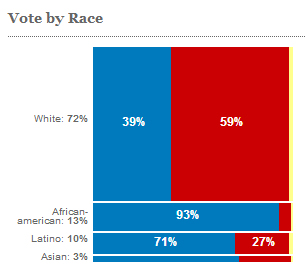
Below is a chart of the demographic breakdown for the presidential election of 2012. As one can clearly see, the Republican Party did well with white voters, but quite poorly with minority voters, a problem brought upon themselves. In recent years, the GOP has taken a combative stance against illegal immigration and minority rights. While some Republicans might blame the message rather than the actual policy, it has been duly noted that the Republican party is not an ardent supporter of immigrant and minority rights. Bills have been passed in states, such as Arizona and Alabama, that would seem to encourage racial profiling to find illegal immigrants.
The results from both the 2008 and 2012 elections do not bode well for Republicans. The demographic is shifting now, with minorities making up a larger portion of the electorate. Now, with two strong showings, the Democrats, at least for now, have the allegiance of this critical groups. The electoral map, therefore, has dramatically changed from previous decades, with Democrats running well in western states as well as Florida.
Here is the electoral map for the 2012 Presidential election:
And here's one for 2012:
As one can see, Obama won Colorado, Nevada, New Mexico, and Florida in both elections, all states that have gone Republican in the past and have been classified as more right leaning. All these states have large Latino populations that are only getting larger. In order to ensure that they can survive on a national scale, the Republican Party must moderate their position on immigration and other issues important to minorities, especially Latinos. It is not just that they have trouble communicating their message. They need to be leaders on the issues that matter to these groups.
There are many risers in the GOP that could help with this, though many are outside of Washington. By adapting their policies, the Republican Party could become more centrist and appeal to many minorities, as well as independents. By becoming more inclusive rather than exclusive, they can promote policies that will benefit all of America rather than some of America and help them become stronger politically, a win-win for Republicans. Advocating fiscal responsibility will resonate with many people and if the party can change a bit and become more innovative when it comes to minority groups, the GOP can become much more formidable in national elections and perhaps make this country a better place.
Sunday, January 1, 2012
GOP Warhawks Do Reason No Favors
In the recent GOP debates, many of the candidates, with the notable exception of Ron Paul, have produced plans to use military action against Iran in retaliation to their efforts at Uranium enrichment. In the process, they are stumbling down the same road as the failure of Iraq and Afghanistan.
We do not need another war, and if we were to go to war, we need more of an endgame strategy than we have right now. We cannot assume we will merely bomb the Iranians into submission and all will be good as gold. Hardly. We need a thorough plan to deal with Iran, one that does not involve bombing. If we did resort to violence, then we must have a strategy to fight and end the war, and what to do to rebuild Iran and our own nation.
Labels:
Afghanistan,
candidates,
GOP,
Iran,
Iraq,
Republicans,
Ron Paul,
strategy
Friday, December 30, 2011
Oh Really? Part 2
In the previous post we detailed how many GOP candidates are idealistic in their promises and pursuit of the presidency.
Reasons for the failure to complete promises include inadequate will, resources, or support for the project. The Democrats, regardless if they are in the majority or minority come January of 2013, will come out in force against the president if he is a Republican. Therefore, the Republican nominee would do well not to be too idealistic, lest they fall down much the same road as Obama has so far.
Oh Really? Part 1
In the GOP nomination race for the presidency, it is apparent that many of the GOP candidates are running into a mode of idealism, if you will. Their pledges and promises about putting America back at the top and getting people jobs is all well and good, but this type of campaigning seems awfully familiar to 2008 when a certain Barack Obama campaigned (successfully) for the presidency as is now being criticized for failing to fulfill similar promises.
Subscribe to:
Posts (Atom)