Showing posts with label International Issues. Show all posts

Sunday, December 2, 2012

A New Global Policy

A major problem that we face when trying to bring about peace around the globe is education levels in developing and war torn countries.  One way to measure this is by looking at the adult literacy rates, then comparing the rates to other countries.
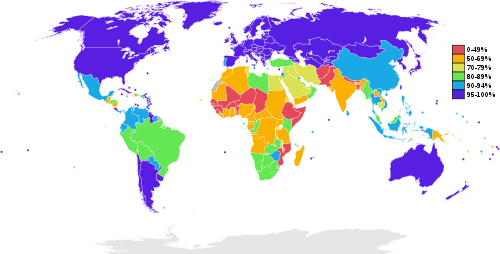
Literacy Rates by country

The results we see are not promising.  Countries in the Middle East have literacy rates significantly lower than those of developed and even developing nation, especially for women.  This translates into fewer opportunities for members of those societies.  Without strong educational institutions, the youth in Middle Eastern and North African Countries have few opportunities to advance themselves, leading to rampant unemployment.

Without opportunities, often the only choice young people have is to associate with terrorist organizations. These young people have no future and no voice.  These young people need to be given a voice that does not involve setting off bombs.  Perhaps the Arab Spring has allowed the young people to find some way of expressing themselves and helped them vent their anger, but more needs to be done. We need to give them more, the future of a higher education.

So how does this affect our foreign policy?

In order to promote peace throughout the world, we must promote literacy and education.  Young, educated people are forces of change throughout the world.  By providing an education to lower class women, we can empower them more than ever before.  Instead of using bombs, we ought to use books to create a new global policy.  The Middle East has extreme poverty and although we may not think it is our problem, we need to make it our problem.  It is much more effective to bring up a country through education than to use crash and burn tactics of military action.

The United States must work with other countries to promote more NGOs to work inside these countries to promote education reform.  They must work with local governments to provide funding for schools.  Additionally, we must open our own doors to these young people who wish to pursue a higher education within the United States.  Politicians at home may not appreciate this policy, but it is much better in the long run to pursue a strategy of youth empowerment than to simply use military action.  We need to pursue a foreign policy of inclusion if we are to bring about peace in the Middle East, not one of exclusion.

Sunday, December 18, 2011

US Must Stop Using Fighting as a Solution in Foreign Policy

A recent trend towards rough and tough militant foreign policy in this nation is worrying.  Instead of fighting to solve its problems, which takes a huge chunk out of our budget, not to mention  many human lives, we should instead pursue active diplomacy with other nations and groups.  Fighting a number of foreign wars only makes us overextended and weaker.  In forging a new time of foreign policy, which is collaborative rather than destructive, other nations might be more receptive to the influence that the United States wields.  By fighting many wars and having an aggressive presence in places like the Middle East, people will often reject the influence as counterproductive and combative.  To turn over a new leaf, the United States must change its outlook and policy on the world.

Friday, May 13, 2011

Next Step in Middle East Policy

The United States must now step up its efforts to make peace in the Middle East.  This is a fractious area, with many socioeconomic groups.  The US must start to clean up its image by helping new governments on the path to democracy.  It will not be easy, and the will be obstacles, but this is better than the fight-and-replace model we have in Afghanistan and Iraq.  At least now the propel are motivated for change.  That energy needs to be harnessed for good.