Showing posts with label series. Show all posts

Tuesday, November 27, 2012

Energy Reform Series: Part 3-The Case For Cap and Trade

In an effort to reduce carbon emissions, there are a few policies that the governemnt could enact that would greatly help to achieve this.  Some methods are better than others and each has its own merits, as well as drawbacks.

The first policy we will analyze is the Cap and Trade approach, championed by many Democrats, as well as flip-flopping Republicans.  Cap and Trade's main goal is to steadily reduce carbon emissions and other pollutants across the nation in a cost effective manner.

Each company or polluter will have a limit, or a cap, on the amount of pollution they can emit.  They are issued pollution permits up to that amount.  If need be, restrictions on pollution can get tighter for more greenhouse gas reduction.  They key part of cap and trade is that companies that efficiently and cheaply cut their pollution levels are free to sell their extra credits to the companies that cannot reduce as easily.  Companies have large flexibility in buying and selling permits, achieving the same total reduction, but at a lower overall cost to the economy.


How is this so?  Well, to start out with, we have to consider the alternative command and control policy.  In command and control, each factory is required to make the necessary reductions, regardless of what the overall cost might be.  The government sets clean air regulations, and companies must either upgrade their facilities, bearing whatever costs are involved, or break the law.

The figure above illustrates this point.  In the traditional command and control approach, the government, for example, mandates a 30% reduction in emissions, or 300 tons of CO2.  The cost to reduce for both plants together is $12,000.  In the case of Cap and Trade, on the other hand, the cost to reduce overall is cheaper.  This is because the revenue made from selling pollution permits to another plant adds additional profit.

Cap and Trade is known as a market-based policy, as opposed to a carbon tax, which would be called a corrective tax.  Market-based policies work within the free market system to provide price incentives for companies or even individuals to reduce consumption.

Cap and Trade could prove an effective tool at reducing pollution if adopted.  We encourage Congress to consider using these market-based policies to effect change in the environmental and energy policy reform.  We can use economics to work for us by providing incentives to do the right thing, while still reducing overall costs.

Monday, November 26, 2012

Energy Reform Series: Part 2

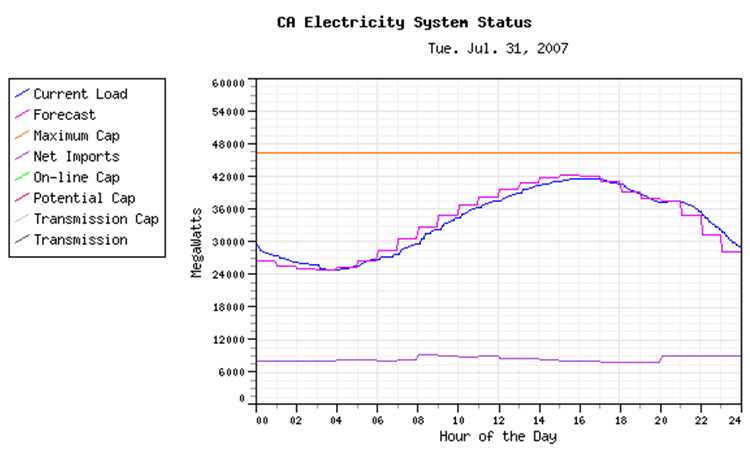
There are  numerous problems with how electricity is distributed.  As you can see in the graphic below, which shows a typical summer day's energy demand in California, energy use in households and businesses varies substantially during the day.  California, as the nation's largest state, can serve as a valid sample for how a large community uses energy.  As energy use continues to rise, the problem of how to apportion energy when use varies so much will only get compounded.

Scientists and economists have brought up this problem multiple times.  As stated in a Technology Review article, published by MIT, simply building more power plants will not solve the problem of so much more demand.  The need for energy is growing so much that too many power plants would have to be built to even provide enough energy for everyone, and setting up a power plant is not cheap.  This creates the problem of what to to to get more energy if building more power plants is not economically viable.

The solution to this problem might lie in smartgrids.  Smartgrids transform an otherwise "dumb" energy allocation system into an intelligent, self optimizing  network.  Tapping into internet based innovations could provide the system with a much needed boost in organizing power.  By bringing the smartgrid to the power industry, we can bring about change similar to that of the Internet on the total economy.

The need for a smartgrid is apparent when we consider a new technology, plug-in hybrids, that are now being used to help ease our oil-addiction woes. According to a study by Oak Ridge Laboratory, 160 new power plants would need to be built if everyone plugged in during the early evening, the peak electricity time.  This is an expensive proposition.  Instead, with a smartgrid, the local utilities could stagger charging times and change rates for off-time power.  With smart technology helping out, virtually none, if any, new power plants would have to be constructed.

Upgrading our nation's grid to become more technologically updated is an expensive public works project.  Though it would be a significant cost, it is likely to pale in comparison to the savings and benefits generated from the change.  The Electrical Power Research Institute estimates that poor reliability and outdated mechanics of the grid costs $100 billion.  With a similar investment, a smart grid, according to their findings, generate trillions in extra annual GDP for the U.S.  By working with legislators, on a local, state and federal level, as well as bringing in consumers and private companies, we can find a way to upgrade our grid and secure prosperity in our future.  The innovation and technology is there.  All we need now is the political willpower.