Showing posts with label reform. Show all posts

Saturday, December 8, 2012

The Fiscal Cliff: Part 3-Simpson Bowles

The Simpson-Bowles Plan is a plan for improving our nation's fiscal situation produced by the National Commission on Fiscal Responsibility and Reform, and named after the commission's co-chairs, former Republican U.S. Senator from Wyoming Alan Simpson and former Clinton Chief of Staff Erskine Bowles, a Democrat.  This commission was created by president Obama in 2010 to identify policies that could be used to solve our budgetary crises.


The Simpson-Bowles Plan goes beyond what many other ideas to reduce deficits entail.  Both Simpson and Bowles bravely recognize the need for increased revenue and reduced spending to get the nation back on the track of financial solvency.  If we want to be serious about reducing our debt, there will be no easy decisions.  Money must come from all places possible, and this includes reforms to the tax code, social security, and the defense budget.


As you can see in the figure above, the Simpson-Bowles proposal (Co-Chair Proposal) goes far beyond what any major party has come up with.  What the plan might lack in depth in any one any it makes up for it in its balanced approach to cutting debt.  Paul Ryan's plan includes more cuts to domestic discretionary spending, but leaves defense spending alone, for the most part.  The Simpson-Bowles approach also increases revenue, partly by eliminating loopholes, partly by raising taxes.  They understand that we cannot have a balanced approach without an increase in revenue.  Until now, we have never fought a war without an accompanying tax increase to pay for it.  Now, with wars in Afghanistan and Iraq, we have had two.  This simply is not sustainable.


We hope that Senators and Congressman, as well as the President, after initially spurning this plan, take a second look at it in the midst of fiscal cliff negotiations.  We need real, concrete plans to cut debt if we are to ensure the financial stability of this nation for years to come.  In coming posts, we will elaborate on details of the plan, and explain why its ideas are important.

Thursday, November 29, 2012

Education Reform


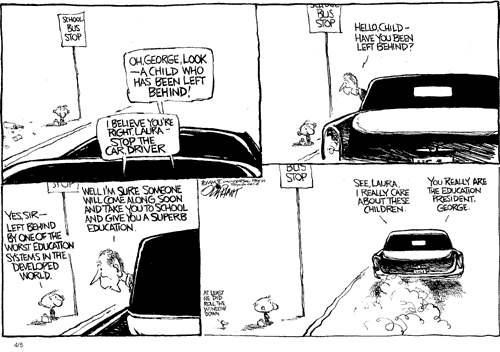
Education is a big area for reform in America.  With the introduction and failure of the No Child Left Behind Act, there is a huge space for new education reform.


While No Child Left Behind highlighted some of the issues in our education system, it did not really fix our problems.

With spending increasing in the education sector of our economy, we have only seen a tiny improvement in scores:
                           

Now, test scores are obviously not everything that matters in education.  The tests that are used no not necessarily measure academic competency.  Even so, with this much money being spent on education, we would expect to see some improvement.  But, in fact, we do not.

Teaching is and will remain some of the most important jobs in America.  The sooner we all realize this, the better we are suited to go about reform.  Teachers instruct and enlighten new generations, driving them towards success.  We need to ensure that those who fill these jobs are both well qualified and well prepared to do this.  One inspiring can make a positive contribution to a students life.  These contributions are often impossible to quantify for wage purposes.  We can, to a certain extent however, pay teachers based on their affect on the students.  Merit based teacher hiring, promotion, and retention will encourage teachers to be the best they can possibly be.
                          

This is not all on the teachers though.  Instructors who teach teachers need to be the best they can be also.  Teachers need to be well prepared so that they can succeed. Ensuring that we have extensive teacher training is essential.  Teachers should be informed on strategies that help motivate students.  They can share their ideas so they all can succeed.  Such collaboration must be encouraged in the education system.

In order to push students to learn more, we must challenge them, but not beyond their limits so that they are overwhelmed.  In our educational system, there are often only two streams: Grade Level and Honors/Advanced Placement.  There is no middle ground.  Often students feel they are unready or unprepared for the most challenging class, but then, devoid of options, are frustrated with the simplicity of the Grade Level Class.

This needs to change.  Teachers in all classes need to asses student skill and willpower to offer or assign tiered assignments varying the challenge that students have.  Some students may not be able to go beyond what Grade Level requires.  Very well.  Others can have a challenge, so that they may still challenge themselves and expand their knowledge without overwhelming themselves.  This would not require any additional "Accelerated" classes from being added to the school course offerings, thus eliminating any additional class/teacher cost.  Though all assignments may not be tiered, as to ensure grade fairness, a significant amount of increased challenged could be added to the courses with this system.  Teachers can assign some tired assignments, and present a choice to the student on others, encouraging students to challenge themselves, but within their limits.  This provides a way for all students, not matter their skill level, to push themselves without increasing their stress level.


We should strive for high standards so America can produce the best and brightest.  It is important for our future as a nation.  We should have more early childhood education opportunities.  Foreign languages should be taught much earlier, such as in elementary school.   Underprivileged children should have the same opportunity to go to and succeed in school as anyone else.  Education is greatly important in our country as we strive for success in the future.  There should be a better system for paying teachers.  Merit pay is one option, but other options could be implicated.  Instead of states “dumbing down” their standards so more kids pass, we should raise standards and make sure we make them.  


More money can be spent in education, but overall, it should be spent more efficiently. We need to evaluate what programs really work in engaging kids, and funding those programs.  With better education, our children will be our future. They will be able to create better renewable energy resources, increase the US front on science and technology, and reach greater achievements on the economy. We must also include a larger range of foreign languages and arts in the studies. This will increase respect for the nation, and our future people will be able to meet with foreign people in an easier fashion. In terms of teachers, they must receive a higher pay. In these times, with huge lay-offs, we must remember, talent not tenure.  
Our education system is broken.  We have students that are struggling and we are locked into a system that rewards teachers for hanging in there the longest, not ones that effectively teach and inspire their students.

W.B. Yeats once said, "Education is not the filling of a bucket, but the lighting of a fire." By challenging our students, we can light student's intellectual fires so they burn bright and powerful into adulthood, catalyzing and illuminating their futures.

Friday, November 23, 2012

Patent Reform

Patents are powerful.  When granted, they give the holder of the patent a government issues monopoly over their product or idea for 20 years.  That's a long head start for people to start producing the product and raking in the dough.

Patents are instrumental to promote innovation, when done correctly.  Patents protect novel ideas and encourage people to come up with new ones.  Because there is the assurance that once someone comes up with something new that that something will be protected from copying, there is an incentive to come up with more ideas.  It rewards those who work hard to develop a product, preventing freeloaders from selling copycat products without investing the time and effort into developing the product.  The more ideas there are, the more innovation and economic growth a country will have.  It's one of the reasons that the United States has been home to innovation hubs like Silicon Valley.

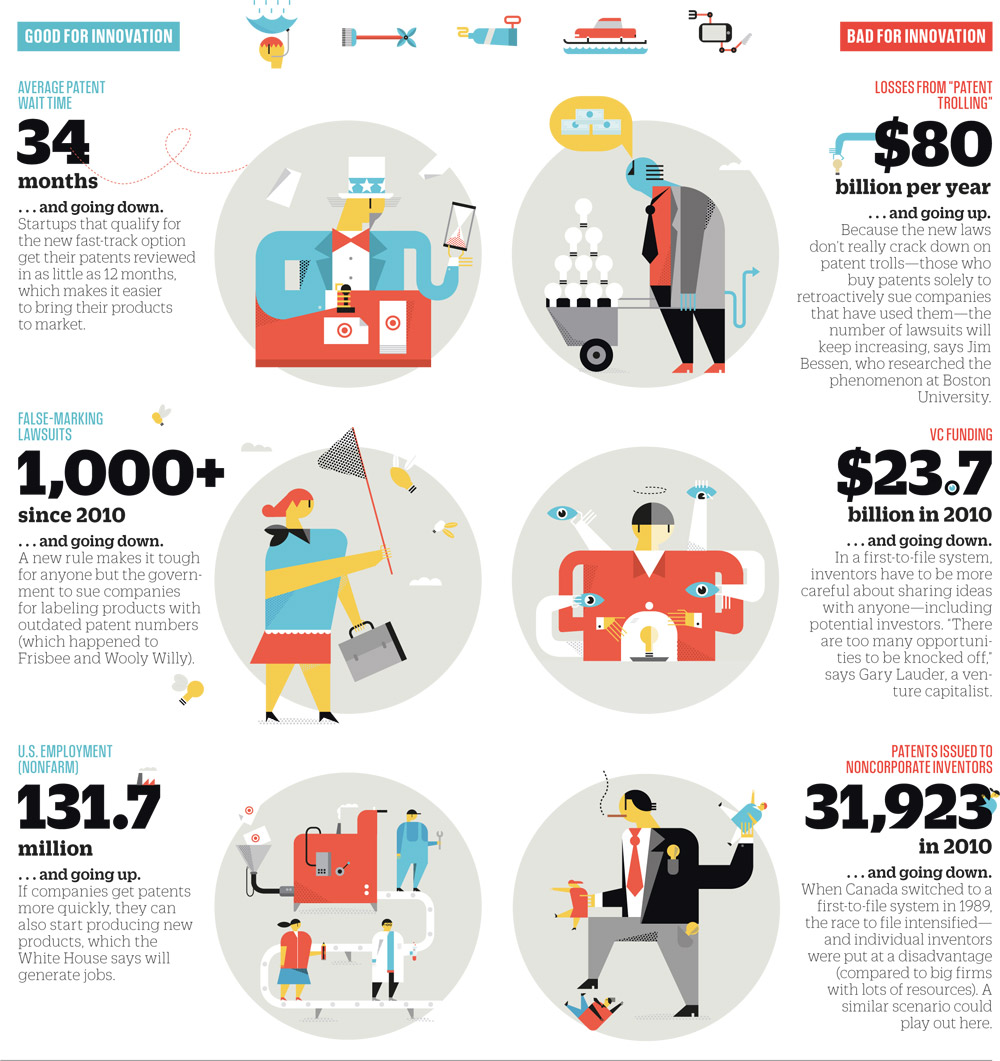
However, despite its strengths, our patent system is in desperate need of an overload.  Take a look at the graphic below.  In recent years, the amount spent on trying to sue for or defend patents has been far greater than the profits associated from those same patents.  Efficient and innovative?  We think not.

Part of the problem is that some patents are too broad.  As the Planet Money Team explains on NPR, the patent office has granted too many patents for simply the general idea, rather than the specific application.  In other words, people are being granted a monopoly for on demand streaming of anything, rather than a particular way to stream music on a portable device.  These patents seem to indicate that the person who owns the patent, owns the area itself.  

This is not what patents are for.  We need to have patents protect actual technological applications, rather then a broad, unclear field.  You can't just say that you want to patent the whole field.  Patents should require specific documentation on how exactly you are going to it.  For example, Samuel Morse, when asking for a patent on the telegraph, asked also for a patent on electromagnetic communication.  Nowadays, this would have wide reaching applications.  The internet, television, fax machine, etc, would all be under control of this patent.

Another problem is that patents are applied for, and sometimes granted for ideas that are obvious to those in the field.  People trying to capitalize off a potential government monopoly on the product want to patent seemingly everything, whether it is a novel idea or not.  This, as you can see in the below graphic, creates a large backlog, flooding the system with illegitimate applications which drown out perfectly genuine and innovative proposals. Getting rid of these obvious patents will clear up some of this backlog, and allow the real innovations to be protected.


Not only is there a backlog of obvious patents, but the whole system seems seriously understaffed.  The patent office is a critical part of the economy.   As stated before, it has the power to grant monopolies for 20 years.  It seems as though this part of government, with such power, ought to have enough resources to make sure it does its job well.  We need to make sure such a backlog never exists and patents are processed in an efficient and timely manner.

Another problem exists in how injunctions are granted for apparent patent violations.  Although the court system has improved in handling this, there is still a long way to go.  In any major electronic product, there are hundreds if not thousands of patents.  If one of these was violated, previously the whole phone could be shut down, even if it was just a infinitesimally small part of the whole electronics and software puzzle that made up the final product.  Now, full injunctions are rarer, but there still needs to be more policy and culture changes in this area.  Fairer and more clearly defined rules could speed up the hearing process, and keep lawsuits out of court.  Overall, proportional damages should be rewarded instead.  The courts should award damages proportionate only to the idea or ideas in question, not the whole product itself.

Below is a report, put together by FastCompany that evaluates recent changes to patent reform, the first such changes since 1952.


FastCompany brings up the critical point on patent trolls-firms that seek and collect patents solely for the ability to sue companies.  Such actions increase the number of lawsuits associated with patents and the costs associated with maintaining them.  If it no longer pays to innovate, then people will simply stop doing it.  The actions of these firms must be stopped.  These firms birdying up their claims in courts that are more likely to decide in their favor.  Therefore, claims need to be brought up in a court that has some reasonable connection to the original claim, not a court of preference to the plaintiff.  Making sure that patents are for specific ideas, rather than broad principles, should also help combat these firms.


In Summary:

We have identified major improvement areas we would like to see the new congress tackle.  With these changes, we will have taken a step towards major patent reform.

Improvement areas:

Improving the quality of patents: Patents need to be written clearly and precisely, and be about a specific idea, rather than a general principle.  The idea must be novel, rather than an obvious principle.

Contributing more resources to the patent office: workers in the US Patent office need to be highly trained to handle the content of the idea submitted. Procedures must be improved to handle the intense volume of patent applications.  More highly trained employees need to be staffed to the patent office to handle the backlog of applications

Halting injunctions and awarding proportionate damages: Patent infringement damages should be awarded proportionately, based on the value of the idea in question rather than the whole product.  Injunctions should not halt the release, sale, or production of a product based on a very small violation.

Ending private hoarding of patents: Measures must be taken to ensure that firms do not collect patents simply to sure other companies.  Plaintiffs should bring their cases to courts with a connection to the issue at hand, rather than to a friendly one.

Saturday, November 17, 2012

Badly Needed Senate Procedure Reforms: Part 2

In the second part of our Senate reform series, we'll discuss secret holds.  In the last post, we discussed the filibuster, used as a means to delay or kill legislation   While the filibuster has been commonly used, especially recently, it is not the only way a senator can stall or stop a bill.

The Senate, it turns out, typically conducts business in the form of unanimous consent, which means that a single member can cause considerable consternation when other senators are trying to pass a measure.  This hold can be done without releasing one's name, hence the term "secret hold".  After some recent changes to the procedure, a senator can hold under anonymity for up to two days.  The problem: senators can still team up.  One will hold fro two days, then another.  The result is a killed bill.


Our proposal:

We need to adapt the rules to hold senators accountable.  Holds can still exist, but all holds should be public.  Senators should then explain to the American people why they have place a hold.  There is then a public record of why the senator is opposed.  Changing these rules should streamline the legislative process and make the system more open and transparent.

QK7UZB788X2Q

Wednesday, December 28, 2011

Politics That Change

Our political system is set up so that the people do not have much of a choice.  When buying products at a store, there is often much more than just 2 choices.  It should be the same for politics, where we should not have such limited choices in who we elect.  Nationally, Republican and Democratic platforms stay relatively constant, dictated by powerful national leaders.  We need politics that is not rigid but politics that can be tinkered and changed to suit the times.

Monday, December 19, 2011

Top Down Authoritarianism Does Not Work

With recent protests in Russia and the Middle East, a theme is clear.  The top down authoritarian style leadership is not working as well, or at all, anymore.  People now doubt their government more than ever, and not just in this country.  This theme is being harnessed, as it should be, to solicit change around the world.  People do not like being talked down to, and justly will not take it anymore.  Now is the time to act against this kind of government, so protesters can ride the wave of discontent.