Showing posts with label economics. Show all posts

Tuesday, April 16, 2013

Problems In Our World: More Complex Than You Might Think

Many of the problems that have arisen over the past decades seem, on face value, to be about religion.  While these conflicts, such as the ones in Northern Ireland and the Middle East, do have religious tensions that lead to escalation, the problems are more complicate than that.

These problems can often be traced back to geopolitical, economic, or social issues.  In its most basic form, conflict arises between those that have resources and those that don't.  Competition for power, supremacy, resources, and many other aspects of a successful society has been fraught with conflict.  As Graham Fuller argues in his book, A World Without Islam, the world would not be too different today without Islam because of these alternate conflicts that exist.  You can hear more about this here, http://www.npr.org/templates/story/story.php?storyId=129131992, where Fuller is interviewed on NPR's Talk of the Nation.

Fuller's Book

If we realize how conflicts come about and realize that we are dealing with a very complex part of the world in the Middle East, we may have more success in our endeavors.  Problems hardly ever boil down to white and black, regardless of how they are painted to the electorate.  Realizing the comprehensiveness of the situation can be our best strategy going forward as we attempt to find peace in the Middle East.


Monday, April 8, 2013

The Importance of Manufacturing

As the United States begins its rebound from the recession, it is important to highlight how important the manufacturing industry is the the our nation's economy.  Manufacturing was one of the economic sectors that was hit hardest by the recession, and many of those jobs will either never or take a very long time to return.  


While there has been a significant increase of offshoring with manufacturing jobs, there is still a lot of work done here in America.  While some would argue that manufacturing is not as critical as it once was to warrant government support because of weak job creation numbers, these people miss a critical part of why we need manufacturing jobs in the United States.

large scale employment is not the main benefit of a strong manufacturing sector in our economy.  Support of manufacturing, specifically advanced manufacturing, will help the United States retain its status as a global hotspot for innovation and technological advancement.  Today, this is the main source of US competitiveness.  We have to realize that we cannot make everything anymore.  Manufacturing on large scales is much cheaper in east Asian countries.  Where we do have an edge, however, is the innovative spirit and technological know-how to come up with and create new technologies that will make world a better place.  

Today, the manufacturing sector makes up only around 11 percent of our nation's GDP.  As you can see from the graph above, the United States has experienced a constant downward trend in this statistic.  This is fairly constant with the rest of the world, on average.  However, despite it small share of GDP, according to the Brookings Institution, the manufacturing sector conducts 68 percent of research and development in the United States.  Brookings also notes that 22 percent of US manufacturers introduce new processes that increase productivity, as opposed to only 8 percent of non-manufacturers.  Additionally, manufacturing took up 60 percent of US exports despite its modest share in GDP.  

Although now a smaller part of our economy, the manufacturing sector is still very critical for the well being of our entire nation.

Monday, December 3, 2012

The Fiscal Cliff Series: Part 1

The term "Fiscal Cliff" is used to describe the problem faced by Congress at present.  A combination of tax cut expiration and automatic cuts will take effect come January 1st if a plan is not produced to avert the situation.  

Because of Congress's failure to come to an agreement in accordance with the Budget Control Act of 2011, which raised the debt ceiling but left open the ways to cut deficit spending.  Since a bargain was not reached, sequestration will occur, which mandates across the board spending cuts.  In addition, the Bush era tax cuts will expire, as will a 2% Social Security Payroll tax cut, and the expiration of federal unemployment benefits.

If Congress doe snot act, as before, the results could be very grim for our country's growth.  It will have a very detrimental effect on an economy that is still shaky.  

The effect of the Fiscal Cliff on GDP
As you can see above, analysts have projected strong negative effects on our nation's GDP if  we run over the Fiscal Cliff.  The Tax Policy Center has stated that middle income families will pay, on average, $2,000 more dollars in taxes in 2013.  The Congressional Budget Office (CBO) also anticipates increased unemployment  where 3.4 million will lose their jobs.

That being said, the country cannot continue on the path it's on with regards to deficit spending.  at least something needs to be done to curb our spending so that we get back on a sustainable debt track as our economy begins to rebound.  Large deficit spending should really only be done it trying economic times, and we should try to steer clear of that now.

The effect of the Fiscal Cliff on Deficit
Now, as we consider the negative effects of the fiscal cliff on growth, we should also note that it would drastically decrease our spending and cause us to run fewer deficits.  The CBO baseline in the figure above shows that effects of the fiscal cliff.  The blue alternative would be the effect of repealing the automatic cuts and extending the Bush Era tax cuts.  Though this also reduces deficits, at least for a while, more would need to be done to put our nation on the track of long term sustainability.  We'll discuss possible solutions to this problem in following posts.

Monday, November 19, 2012

Debt vs. Deficit

Debt and deficit.  People often confuse the two.  Republican pundits attack Democratic policies on both.

A deficit occurs when all government incomes, called receipts, are less than the amount of government expenditures, called outlays.  Revenues come from income and other forms of taxes.  Expenditures result from a variety of purchases and entitlements. Since a deficit involves only a year's receipts and outlays, it applies to just one year. If the government took in $14 trillion and spent $15 trillion, the deficit would be $1 trillion.

When the government runs a deficit for a certain year, they need to borrow money in order to pay their bills.  To do so, the Federal Reserve can print some or all of the shortfall, but this typically leads to inflation.  How much inflation occurs depends on the amount printed.  If everyone has more money, and there are the same number of products, then those products will become more expensive.


Usually, instead of printing money, the government operates in credit markets, issuing bonds, like private companies can.  A bond is a form of a loan.  when the US Treasury issues its bonds, it means it is promising to pay that money, which it needs now, in the future.  When governments issue bonds, investors buy them up, selling them on secondary markets.

Debt, on the other hand, is basically accumulated deficits.  If the government has to keep issuing bonds, borrowing money each year to pay its outlays, then the debt will continue to grow.


Debt typically grows each year.  With each successive deficit, the debt, or at least the gross debt, will continue to grow.  A misconception is that if the government takes in more than it spends, that its receipts are greater than its outlays, that there is no debt.  This just means that the government has managed to run a surplus, but all debt that was accumulated previous years is still there.

It is accepted by most economists that some debt, sometimes, is a good thing for the nation and the economy.  When in a recession, tax revenue falls because of the lack of business and personal growth.  If tax rates are slashed, the revenues will fall even more.  The government also spends more on its social  programs such as unemployment insurance/benefits, so the government should run a deficit in order to pay for all that.  Conservatives argue that deficits in bad times need to be offset by surpluses in good times.  However, this does not need to be the case, when we consider debt in relation to our nations economic productivity, the GDP.


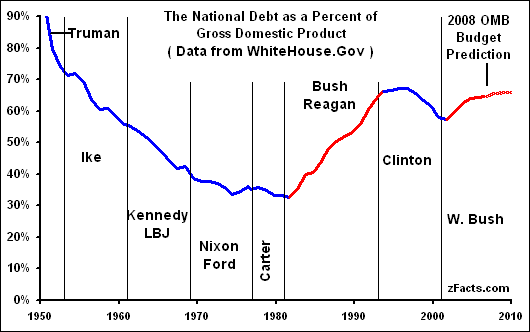
If the debt remains at a steady percentage of our GDP, the government can sustain that level of debt, even if they run deficits forever.  Consider the following: if the government has debt of 30% of its GDP at the start of a year, and it ran a balanced budget, even though the gross debt stayed the same, the percent with respect to GDP will go down.  The GDP almost always goes up.

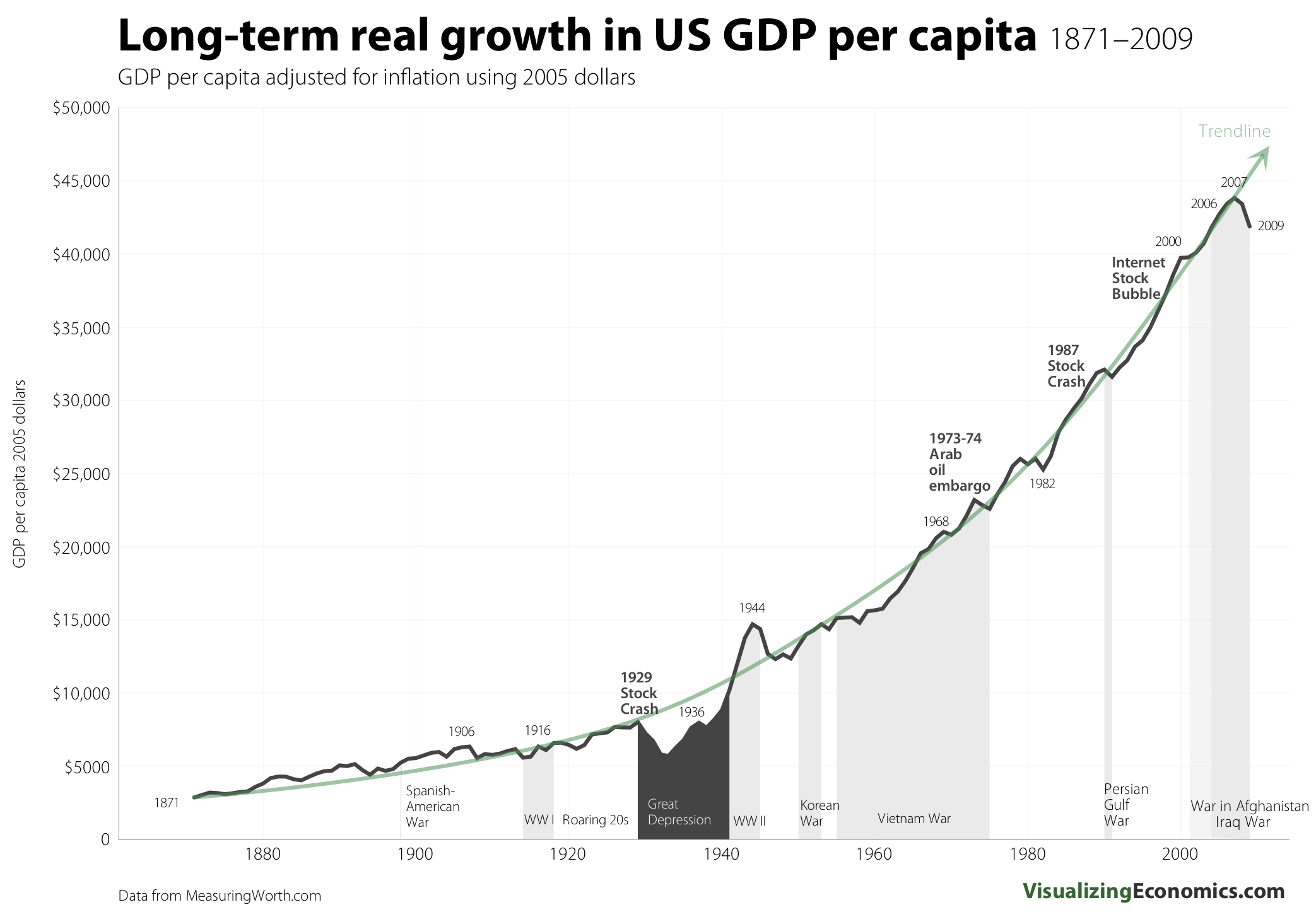
The more our GDP grows, the more debt we can afford to take on.  GDP is basically an equivalent of the nation's tax base.  The more growth in the country, the more profits and salaries will rise, and the more tax revenue for the government.

There are negatives to government debt.  When the government has to continually issue bonds, these bonds compete with private ones on the investor's market, pushing up interest rates.  The more money the government takes from this market, the less money there is for the private sector.

Debt does have many positives though.  Families, for example, go into debt and borrow money in order to buy a house or pay for college.  The accumulated deficit of paying for one of these lasts for many years, but people still manage to pay it off.  Debt makes the benefits of owning a house and higher education reachable for more people.  Companies operate the same way, obtaining loans in order to expand, hoping for more profit later on.  In the same way, government can go into manageable debt in order to pay for items that its citizens deem important.

Tuesday, February 28, 2012

Economic Climate


Instead of the government picking winners and losers in the entrepreneurship field, they should foster a climate that promotes entrepreneurship.  The relationship with the government and businesses should not be one of conflict.  The economy can be private and public sector collaboration with both doing their part to ensure strong and sustainable growth.  The private sector will do the bulk of the growth, while a role for the public sector would be to maintain sustainability in that growth.  This cooperative relationship should facilitate growth and promote growth, not impede it.  In forming a sustainable plan, it is important to note that sustainability does not mean “restrict growth” but instead planning and coordinating growth in a way that that increase can be sustained.

Below, for reference, is the White House plan for sustainable growth:


General Economic Principles

Throughout history, economic growth has gone hand in hand with a strong and industrious middle class.  Efforts must be made to strengthen and enlarge the middle class, by bringing people up rather than bringing people down.

In recent decades, the size of the middle class has fallen, which must change, for the economic vitality of this country is strongly dependent on the vitality of the middle class.

Friday, December 30, 2011

More On Economic Climate

The economy can be a private and public sector collaboration with both doing their part to ensure strong and sustainable growth. The private sector will do the bulk of the growth, while a role for the public sector would be to maintain sustainability in that growth. This cooperative relationship should facilitate growth and promote growth, not impede it. In forming a sustainable plan, it is important to note that sustainability does not mean “restrict growth” but instead planning and coordinating growth in a way that that increase can be sustained.

Increase Creative Capital

To grow our national economy, we need to boost of creative capital, our capacity to innovate and create new items for the market.

Innovation can drive to market forward.  We have seen this time and time again in Silicon Valley.  Many countries have seen the benefit in this and tried to create their own havens for technological innovation.  The United States, if they are intelligent, would do well to preempt the action of other nations and develop even more thoroughly innovative centers of its own, not just in Silicon Valley.

Thursday, December 29, 2011

Economic Climate


Instead of the government picking winners and losers in the entrepreneurship field, they should foster a climate that promotes entrepreneurship.  Small businesses drive this nation forward, and the government should do what it can to foster a climate that promotes small businesses. The government should not be at odds with the private sector.  It should be an effective partnership to promote sustainable growth.  

Wednesday, May 18, 2011

Entitlement Reform is Needed

Paul Ryan has recenlty proposed an overhaul of Medicare that would significantly change the program.  While his version of the solution is not ideal, it certainly is bold and brings up the issue of entitlement reform.

Medicare and other programs will soon get too expensive for the government to keep paying for.  As a result, the debt will continue to go up if spending is not slashed.  We must now open a debate on the programs that we hold dear.  It feels so good to have so many programs, but at the same time, government cannot always sustain it.  We must look to ways we can streamline cost for entitlements, cutting out waste, then discussing alternative cutting measures.

Paul Ryan's budget is only the first step towards the process.  His solution is not the best, nor should it be adopted, but a discussion must ensue on what we really want from our healthcare and what we really want from or entitlement programs.

Reform Needed to Spur Economy

The middle class is reeling after a long recession, which is still not over.  In order to facilitate recovery, we must have a middle class tax break in order to help families cope with the economic downturn.  Seeing as the middle class is often hurt he most in a recession like this, they should get the tax break, not the wealthiest Americans, who can afford it.  Cutting taxes for the rich in a time where we have extreme debt is not prudent or logical.

In addition, we need to make it easier for people to start small businesses.  Encourage lending and venture capital, as well as tax breaks for America's smallest companies, which help drive struggling local economies forward as large corporations are sending jobs overseas.  renewed economic reform is critical as we aim to rid ourselves of the bonds of this recession.

Wednesday, May 4, 2011

Basic Finances

In order to remain fiscally responsible and free of debt, many American families and businesses adopt a simple principle: don't spend more than you take in.  It's simple finances.  School groups do it.  Lemonade stands do it. Lots of people do this.  The question remains: why doesn't the federal government do this?

The feds have been lax on what kind of debt they will allow, and both parties are to blame for this is some way or another.  Yes, Democrats traditionally win the yearly overspending contest, but Republicans insistence on only cutting spending while at the same time cutting taxes, often for the rich, wins no prize for its responsibility.  Both parties spend huge amounts on foreign wars.

It makes little sense to only cut spending or only raise taxes in order to cut the deficit.  Using only one of these methods ends up with a tougher strain on the middle class and/or Government with to little funding too effectively complete its job.  Exercising both options tempers the harshness.  Cutting taxes on the wealthiest Americans makes the most sense, since they are the ones that can afford it.  One thing that politicians must realize is that these taxes are never really going to redistribute the wealth.  When the rich are taxed more, they will still be rich.  When the middle class is taxed less, they are still in the middle class.

All this, though, does not take away the responsibility of the Federal Government to spend its money wisely.  Its our money.  Fiscal responsibility is imperative.  Cut programs that don't work and aren't effective, and reward programs that do more with less.  There are ways to do the same job with less money, and it still doesn't mean less workers.

Spending money wisely is basic economics; its about time Washington learned its lessons.

Tuesday, May 3, 2011

Economics

Democrats and Republicans go on and on about spending and taxes but none of them have the real solution.  The Democrats have to realize that there is more in life than spending government money as much as they want, and the Republicans have to realize that they can’t always demand no taxes.  Taxes are essential for government to function.  But also, the government must also be more efficient and careful in the way they spend money.  No wasteful spending is mandatory.  Tax cuts should be for the poor and middle class and the super rich, who can afford it, should be taxed more.  One thing politicians don’t realize is that these taxes aren't going to redistribute the wealth.  When the rich are taxed more, they’re still rich.  When the middle class gets a tax cut, they’re still in the middle class.   The tax cut just helps them to stay where they are.  This compromise is the best solution to our economic problems.