Sunday, December 2, 2012

A New Global Policy

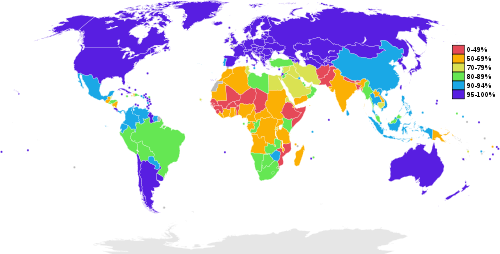
A major problem that we face when trying to bring about peace around the globe is education levels in developing and war torn countries.  One way to measure this is by looking at the adult literacy rates, then comparing the rates to other countries.

Literacy Rates by country

The results we see are not promising.  Countries in the Middle East have literacy rates significantly lower than those of developed and even developing nation, especially for women.  This translates into fewer opportunities for members of those societies.  Without strong educational institutions, the youth in Middle Eastern and North African Countries have few opportunities to advance themselves, leading to rampant unemployment.

Without opportunities, often the only choice young people have is to associate with terrorist organizations. These young people have no future and no voice.  These young people need to be given a voice that does not involve setting off bombs.  Perhaps the Arab Spring has allowed the young people to find some way of expressing themselves and helped them vent their anger, but more needs to be done. We need to give them more, the future of a higher education.

So how does this affect our foreign policy?

In order to promote peace throughout the world, we must promote literacy and education.  Young, educated people are forces of change throughout the world.  By providing an education to lower class women, we can empower them more than ever before.  Instead of using bombs, we ought to use books to create a new global policy.  The Middle East has extreme poverty and although we may not think it is our problem, we need to make it our problem.  It is much more effective to bring up a country through education than to use crash and burn tactics of military action.

The United States must work with other countries to promote more NGOs to work inside these countries to promote education reform.  They must work with local governments to provide funding for schools.  Additionally, we must open our own doors to these young people who wish to pursue a higher education within the United States.  Politicians at home may not appreciate this policy, but it is much better in the long run to pursue a strategy of youth empowerment than to simply use military action.  We need to pursue a foreign policy of inclusion if we are to bring about peace in the Middle East, not one of exclusion.

Saturday, December 1, 2012

Energy Reform Series: Part 4-The Economics of a Carbon Tax

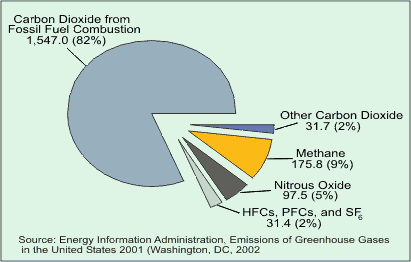
Considering the rise fossil fuel emissions, especially those of carbon dioxide, something ought to be done in the form of policy change to promote reduction of pollution.  In this post, we will look at one idea, a carbon tax, which would be imposed on industry to promote reduction in fossil fuel use.


Taxes would be levied on carbon use.  Energies such as coal or gasoline would have a much higher rate than solar or wind power.  These clean sources of power would likely not be taxed at all.  Firms have a strong incentive to adopt whatever new technology is necessary to reduce their carbon footprint.

The draw of a carbon tax over Cap and Trade is its simplicity.  Cap and Trade involves the buying and selling of carbon credits with other companies.  The Carbon Tax simply levels a tax on carbon use on all companies.  This would also mean a carbon tax could be implemented much more quickly than a cap and trade system. From a government's perspective, the carbon tax could be more beneficial, as it supplies additional revenue to their coffers.

However, this could also mean higher energy prices for consumers.  The government might have more money, but one way to get around tax for energy companies would be to simply raise rates.  This could be a very negative effect of trying to fix a very important problem.

One way to solve this problem is to change the way the money is allocated once it is collected from the polluters.  Since households would be paying more, it makes sense to alleviate them of a burden that was supposed to be placed on major polluters.


To do this, the government would use the money collected to pay out benefits or provide tax breaks to households that would bear a burden from paying the higher rates.  This makes the whole system revenue neutral.  This would be preferable over simply levying a tax.  This way, consumers can actually make a profit by implementing their own energy saving measures, instead of just holding steady or paying their original bill.

Whether it's the Carbon Tax or Cap and Trade, Congress must act soon on establishing some method of reducing our fossil fuel consumption.  Profit is a huge incentive for businesses, and anything that cuts into that profit is an unwelcome burden on businesses.  We need to use financial incentives for our advantage when it comes to energy policy.  Both Cap And Trade and the Carbon Tax do this: they make it worth a business's while to invest in ways to reduce consumption and increase efficiency. If we do this, we can make sure that our commercial and industrial sector of the economy is clean and efficient, paving the way for energy independence.   

Thursday, November 29, 2012

Education Reform


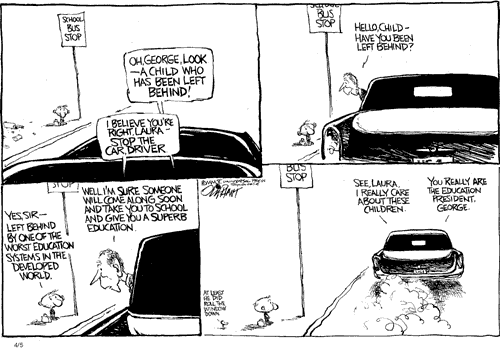
Education is a big area for reform in America.  With the introduction and failure of the No Child Left Behind Act, there is a huge space for new education reform.


While No Child Left Behind highlighted some of the issues in our education system, it did not really fix our problems.

With spending increasing in the education sector of our economy, we have only seen a tiny improvement in scores:
                           

Now, test scores are obviously not everything that matters in education.  The tests that are used no not necessarily measure academic competency.  Even so, with this much money being spent on education, we would expect to see some improvement.  But, in fact, we do not.

Teaching is and will remain some of the most important jobs in America.  The sooner we all realize this, the better we are suited to go about reform.  Teachers instruct and enlighten new generations, driving them towards success.  We need to ensure that those who fill these jobs are both well qualified and well prepared to do this.  One inspiring can make a positive contribution to a students life.  These contributions are often impossible to quantify for wage purposes.  We can, to a certain extent however, pay teachers based on their affect on the students.  Merit based teacher hiring, promotion, and retention will encourage teachers to be the best they can possibly be.
                          

This is not all on the teachers though.  Instructors who teach teachers need to be the best they can be also.  Teachers need to be well prepared so that they can succeed. Ensuring that we have extensive teacher training is essential.  Teachers should be informed on strategies that help motivate students.  They can share their ideas so they all can succeed.  Such collaboration must be encouraged in the education system.

In order to push students to learn more, we must challenge them, but not beyond their limits so that they are overwhelmed.  In our educational system, there are often only two streams: Grade Level and Honors/Advanced Placement.  There is no middle ground.  Often students feel they are unready or unprepared for the most challenging class, but then, devoid of options, are frustrated with the simplicity of the Grade Level Class.

This needs to change.  Teachers in all classes need to asses student skill and willpower to offer or assign tiered assignments varying the challenge that students have.  Some students may not be able to go beyond what Grade Level requires.  Very well.  Others can have a challenge, so that they may still challenge themselves and expand their knowledge without overwhelming themselves.  This would not require any additional "Accelerated" classes from being added to the school course offerings, thus eliminating any additional class/teacher cost.  Though all assignments may not be tiered, as to ensure grade fairness, a significant amount of increased challenged could be added to the courses with this system.  Teachers can assign some tired assignments, and present a choice to the student on others, encouraging students to challenge themselves, but within their limits.  This provides a way for all students, not matter their skill level, to push themselves without increasing their stress level.


We should strive for high standards so America can produce the best and brightest.  It is important for our future as a nation.  We should have more early childhood education opportunities.  Foreign languages should be taught much earlier, such as in elementary school.   Underprivileged children should have the same opportunity to go to and succeed in school as anyone else.  Education is greatly important in our country as we strive for success in the future.  There should be a better system for paying teachers.  Merit pay is one option, but other options could be implicated.  Instead of states “dumbing down” their standards so more kids pass, we should raise standards and make sure we make them.  


More money can be spent in education, but overall, it should be spent more efficiently. We need to evaluate what programs really work in engaging kids, and funding those programs.  With better education, our children will be our future. They will be able to create better renewable energy resources, increase the US front on science and technology, and reach greater achievements on the economy. We must also include a larger range of foreign languages and arts in the studies. This will increase respect for the nation, and our future people will be able to meet with foreign people in an easier fashion. In terms of teachers, they must receive a higher pay. In these times, with huge lay-offs, we must remember, talent not tenure.  
Our education system is broken.  We have students that are struggling and we are locked into a system that rewards teachers for hanging in there the longest, not ones that effectively teach and inspire their students.

W.B. Yeats once said, "Education is not the filling of a bucket, but the lighting of a fire." By challenging our students, we can light student's intellectual fires so they burn bright and powerful into adulthood, catalyzing and illuminating their futures.

Wednesday, November 28, 2012

A Changing of the Guard: US policy change in the Middle East

As the saying goes, the biggest export for America is freedom, and with thousands of US military personal and years of involvement, no other region has been on the receiving end of more American "freedom" than the Middle East.  However, this exporting has gotten extremely unpopular at home and abroad.  This change in opinion combined with the dramatic political changes in the region over the past two years has left many wondering what the new role for the United States is in this volatile region of the globe. The implications of our policies are huge, with the billion dollar question being who steps up to be the power player if the US goes into retirement.


One player who seems eager to step up to the Broadway stage is Egyptian president Mohamed Morsi.  Recently elected after the fall of the formerly US backed Mubarak regime.  He has been shrewd thus far, balancing his base in the Muslim Brotherhood and as a leader in the predominantly Muslim Middle East but also extending a more friendly hand to Israel to balance western interests. But just days ago, he announced that his decisions would be immune from review by law, a power grab that is angering citizens whose experience of Mubarak are fresh in their minds.  Also, how well will the US be able to work diplomatically with Egypt, as conservative members at home consider the Muslim brotherhood to be a terrorist organization.  
Mohamed Morsi
With respect to sovereign governments, the US needs to stop it's double standard of committing on face value to the pillars of democracy while blatantly controlling the governments.  Instances such as the installation of the shah in Iran in 1953 lead to future hard feelings.  The US needs to instead back the right of self determination for all people.

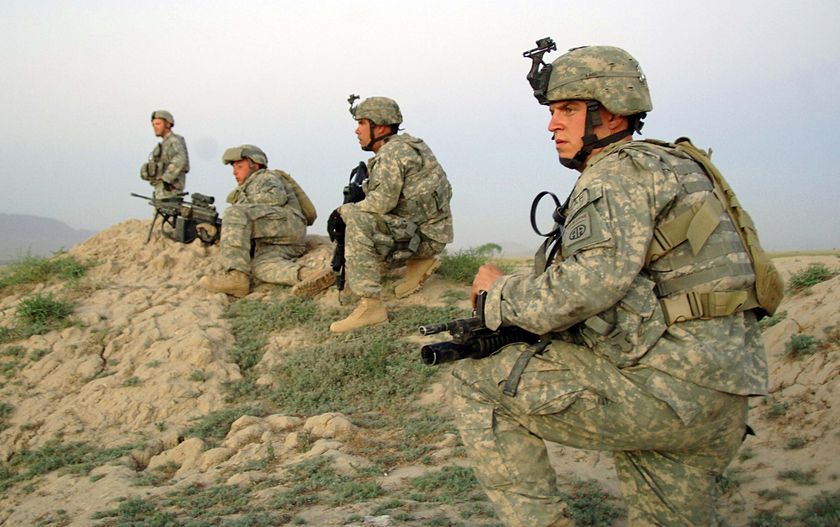
That being said, the US should not necessarily stand by, though we should not get overly involved.  Overextended empires fail, so we cannot over commit resources to unnecessary problems.  Using our own interests as a measure for criteria,  we then can use our diplomatic bargaining power to look out for our interests without compromising the integrity of a sovereign government.  If we get too involved in a country, we might break it, and if we break it, we own it.  That is one of the problems setting us back in Afghanistan:  we're stuck if we leave and we're stick if we don't.


The United States needs to adopt a foreign policy that is more in tune with the times we are in.  We should opt for engagement, instead of containment  and use diplomatic means whenever possible.  We should avoid overextending our resources and seek to empower other nations instead of setting up democracy for them.  If we maintain an open and inclusive foreign policy, perceptions on the United States might, over time, change for the better, and we can better work with other nations to make the world a better place.  This policy change is incredibly important, especially in dealing with an area as volatile as the Middle East.

Tuesday, November 27, 2012

Energy Reform Series: Part 3-The Case For Cap and Trade

In an effort to reduce carbon emissions, there are a few policies that the governemnt could enact that would greatly help to achieve this.  Some methods are better than others and each has its own merits, as well as drawbacks.

The first policy we will analyze is the Cap and Trade approach, championed by many Democrats, as well as flip-flopping Republicans.  Cap and Trade's main goal is to steadily reduce carbon emissions and other pollutants across the nation in a cost effective manner.

Each company or polluter will have a limit, or a cap, on the amount of pollution they can emit.  They are issued pollution permits up to that amount.  If need be, restrictions on pollution can get tighter for more greenhouse gas reduction.  They key part of cap and trade is that companies that efficiently and cheaply cut their pollution levels are free to sell their extra credits to the companies that cannot reduce as easily.  Companies have large flexibility in buying and selling permits, achieving the same total reduction, but at a lower overall cost to the economy.


How is this so?  Well, to start out with, we have to consider the alternative command and control policy.  In command and control, each factory is required to make the necessary reductions, regardless of what the overall cost might be.  The government sets clean air regulations, and companies must either upgrade their facilities, bearing whatever costs are involved, or break the law.

The figure above illustrates this point.  In the traditional command and control approach, the government, for example, mandates a 30% reduction in emissions, or 300 tons of CO2.  The cost to reduce for both plants together is $12,000.  In the case of Cap and Trade, on the other hand, the cost to reduce overall is cheaper.  This is because the revenue made from selling pollution permits to another plant adds additional profit.

Cap and Trade is known as a market-based policy, as opposed to a carbon tax, which would be called a corrective tax.  Market-based policies work within the free market system to provide price incentives for companies or even individuals to reduce consumption.

Cap and Trade could prove an effective tool at reducing pollution if adopted.  We encourage Congress to consider using these market-based policies to effect change in the environmental and energy policy reform.  We can use economics to work for us by providing incentives to do the right thing, while still reducing overall costs.

Monday, November 26, 2012

Energy Reform Series: Part 2

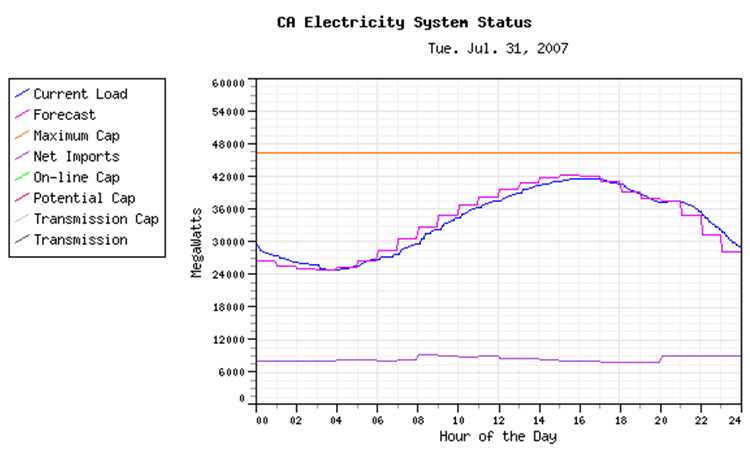
There are  numerous problems with how electricity is distributed.  As you can see in the graphic below, which shows a typical summer day's energy demand in California, energy use in households and businesses varies substantially during the day.  California, as the nation's largest state, can serve as a valid sample for how a large community uses energy.  As energy use continues to rise, the problem of how to apportion energy when use varies so much will only get compounded.

Scientists and economists have brought up this problem multiple times.  As stated in a Technology Review article, published by MIT, simply building more power plants will not solve the problem of so much more demand.  The need for energy is growing so much that too many power plants would have to be built to even provide enough energy for everyone, and setting up a power plant is not cheap.  This creates the problem of what to to to get more energy if building more power plants is not economically viable.

The solution to this problem might lie in smartgrids.  Smartgrids transform an otherwise "dumb" energy allocation system into an intelligent, self optimizing  network.  Tapping into internet based innovations could provide the system with a much needed boost in organizing power.  By bringing the smartgrid to the power industry, we can bring about change similar to that of the Internet on the total economy.

The need for a smartgrid is apparent when we consider a new technology, plug-in hybrids, that are now being used to help ease our oil-addiction woes. According to a study by Oak Ridge Laboratory, 160 new power plants would need to be built if everyone plugged in during the early evening, the peak electricity time.  This is an expensive proposition.  Instead, with a smartgrid, the local utilities could stagger charging times and change rates for off-time power.  With smart technology helping out, virtually none, if any, new power plants would have to be constructed.

Upgrading our nation's grid to become more technologically updated is an expensive public works project.  Though it would be a significant cost, it is likely to pale in comparison to the savings and benefits generated from the change.  The Electrical Power Research Institute estimates that poor reliability and outdated mechanics of the grid costs $100 billion.  With a similar investment, a smart grid, according to their findings, generate trillions in extra annual GDP for the U.S.  By working with legislators, on a local, state and federal level, as well as bringing in consumers and private companies, we can find a way to upgrade our grid and secure prosperity in our future.  The innovation and technology is there.  All we need now is the political willpower.

Saturday, November 24, 2012

Energy Reform Series: Part 1

The United States has a huge energy problem.  Gas price fluctuations throughout the year show us the fragility of our oil supply and our unhealthy dependence on petroleum for energy.  Coal mining accidents, very tragic occurrences, also force us to question our attachment to a resource that pollutes the environment so much.


The United States uses far too much resources like coal and oil and far to little of resources like solar and wind.  Yes, part of the reason is the price of the energy, but these polluting resources also have an unquantifiable environmental price.  Additionally, with government and private sector help, we can make these forms of energy cheap and efficient.

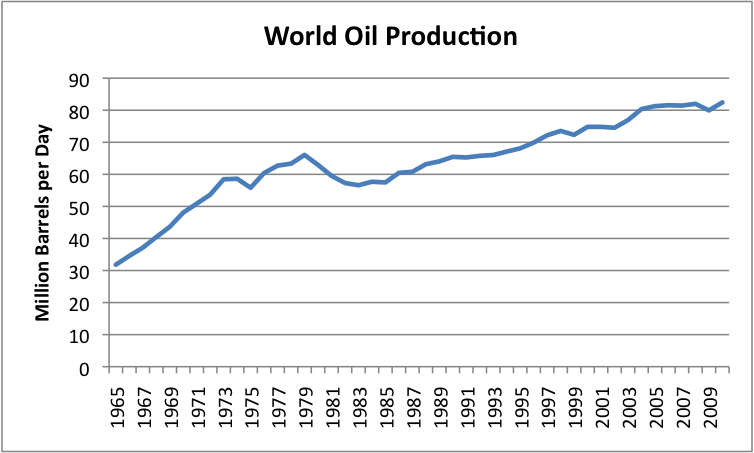
world oil production has increased in recent decades

Conservatives who wail that the government should not get involved should take a history lesson.  A lot of change has come out of government action, and for the better.  NASA, for a while, was the sole consumer of major computers, sustaining an infant industry that has now led to a huge tech sector in the United States.  A form of the Internet was started by the Department of Defense.  Government investment has lead to University funding and the Space Race.  Therefore, we can safely say that there is a place and time for government investment.

We need to make sure that we, as a country, jump ahead and capitalize on energy reform.  If America does not take the lead, some other country will do so, and we will have to buy it from them.  Coming up with and manufacturing the new clean energy technology does not require vast oil reserves or coal mines.  All it requires is an innovative spirit, ingenuity, a bit of private capital, and political will.  We have all of these, to varying extents, right here in America.  The only thing lacking in any regard would be political will.  We need leadership in Washington and around the country to kick-start a clean energy revolution.

By bringing in government investment and private capital, we can diversify our energy sources and make sure  it is affordable and the industry is sustainable.  The US can then become a leader on the world stage, exporting this technology to the rest of the globe.  By being a leader in clean energy, the US could mitigate the influence OPEC countries like Iran wield simply because they have oil.  By acting now, the US can secure its place in the energy hierarchy of the globe.

Friday, November 23, 2012

Patent Reform

Patents are powerful.  When granted, they give the holder of the patent a government issues monopoly over their product or idea for 20 years.  That's a long head start for people to start producing the product and raking in the dough.

Patents are instrumental to promote innovation, when done correctly.  Patents protect novel ideas and encourage people to come up with new ones.  Because there is the assurance that once someone comes up with something new that that something will be protected from copying, there is an incentive to come up with more ideas.  It rewards those who work hard to develop a product, preventing freeloaders from selling copycat products without investing the time and effort into developing the product.  The more ideas there are, the more innovation and economic growth a country will have.  It's one of the reasons that the United States has been home to innovation hubs like Silicon Valley.

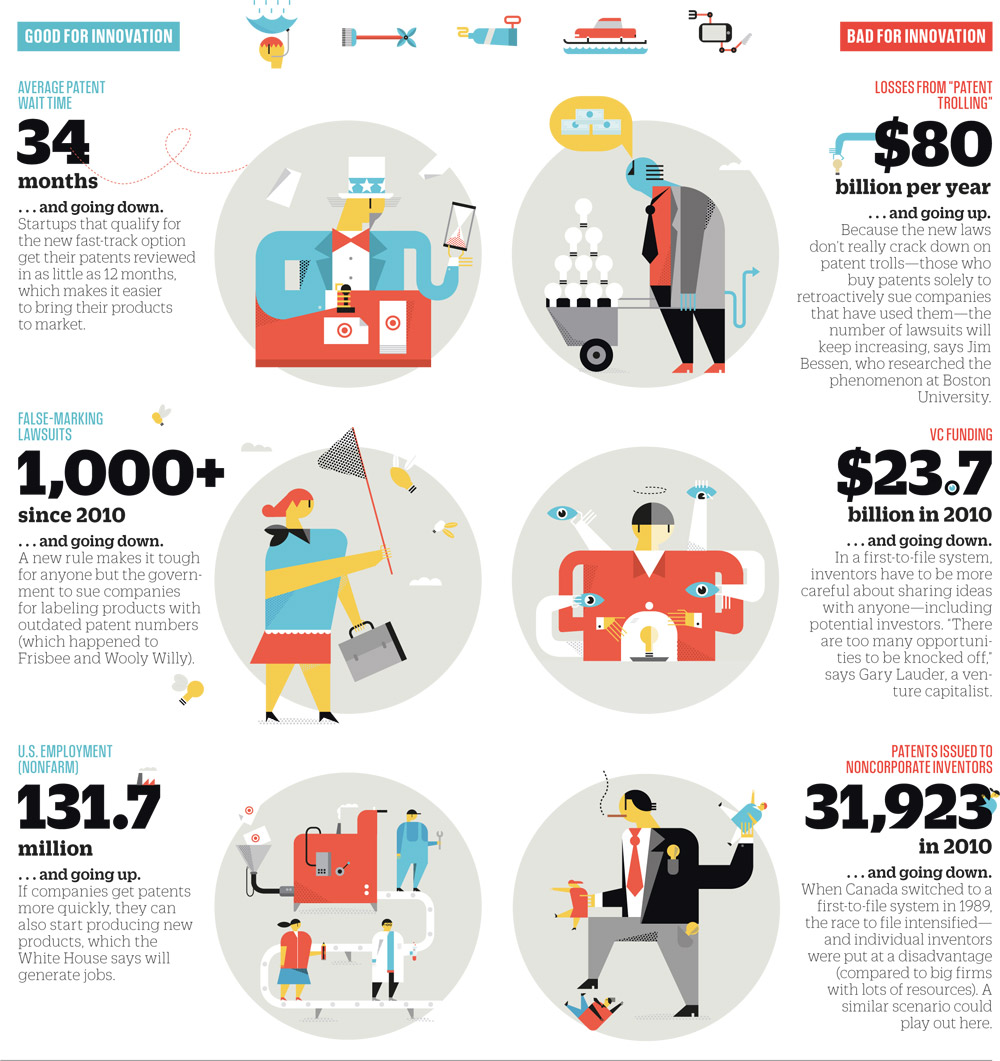
However, despite its strengths, our patent system is in desperate need of an overload.  Take a look at the graphic below.  In recent years, the amount spent on trying to sue for or defend patents has been far greater than the profits associated from those same patents.  Efficient and innovative?  We think not.

Part of the problem is that some patents are too broad.  As the Planet Money Team explains on NPR, the patent office has granted too many patents for simply the general idea, rather than the specific application.  In other words, people are being granted a monopoly for on demand streaming of anything, rather than a particular way to stream music on a portable device.  These patents seem to indicate that the person who owns the patent, owns the area itself.  

This is not what patents are for.  We need to have patents protect actual technological applications, rather then a broad, unclear field.  You can't just say that you want to patent the whole field.  Patents should require specific documentation on how exactly you are going to it.  For example, Samuel Morse, when asking for a patent on the telegraph, asked also for a patent on electromagnetic communication.  Nowadays, this would have wide reaching applications.  The internet, television, fax machine, etc, would all be under control of this patent.

Another problem is that patents are applied for, and sometimes granted for ideas that are obvious to those in the field.  People trying to capitalize off a potential government monopoly on the product want to patent seemingly everything, whether it is a novel idea or not.  This, as you can see in the below graphic, creates a large backlog, flooding the system with illegitimate applications which drown out perfectly genuine and innovative proposals. Getting rid of these obvious patents will clear up some of this backlog, and allow the real innovations to be protected.


Not only is there a backlog of obvious patents, but the whole system seems seriously understaffed.  The patent office is a critical part of the economy.   As stated before, it has the power to grant monopolies for 20 years.  It seems as though this part of government, with such power, ought to have enough resources to make sure it does its job well.  We need to make sure such a backlog never exists and patents are processed in an efficient and timely manner.

Another problem exists in how injunctions are granted for apparent patent violations.  Although the court system has improved in handling this, there is still a long way to go.  In any major electronic product, there are hundreds if not thousands of patents.  If one of these was violated, previously the whole phone could be shut down, even if it was just a infinitesimally small part of the whole electronics and software puzzle that made up the final product.  Now, full injunctions are rarer, but there still needs to be more policy and culture changes in this area.  Fairer and more clearly defined rules could speed up the hearing process, and keep lawsuits out of court.  Overall, proportional damages should be rewarded instead.  The courts should award damages proportionate only to the idea or ideas in question, not the whole product itself.

Below is a report, put together by FastCompany that evaluates recent changes to patent reform, the first such changes since 1952.


FastCompany brings up the critical point on patent trolls-firms that seek and collect patents solely for the ability to sue companies.  Such actions increase the number of lawsuits associated with patents and the costs associated with maintaining them.  If it no longer pays to innovate, then people will simply stop doing it.  The actions of these firms must be stopped.  These firms birdying up their claims in courts that are more likely to decide in their favor.  Therefore, claims need to be brought up in a court that has some reasonable connection to the original claim, not a court of preference to the plaintiff.  Making sure that patents are for specific ideas, rather than broad principles, should also help combat these firms.


In Summary:

We have identified major improvement areas we would like to see the new congress tackle.  With these changes, we will have taken a step towards major patent reform.

Improvement areas:

Improving the quality of patents: Patents need to be written clearly and precisely, and be about a specific idea, rather than a general principle.  The idea must be novel, rather than an obvious principle.

Contributing more resources to the patent office: workers in the US Patent office need to be highly trained to handle the content of the idea submitted. Procedures must be improved to handle the intense volume of patent applications.  More highly trained employees need to be staffed to the patent office to handle the backlog of applications

Halting injunctions and awarding proportionate damages: Patent infringement damages should be awarded proportionately, based on the value of the idea in question rather than the whole product.  Injunctions should not halt the release, sale, or production of a product based on a very small violation.

Ending private hoarding of patents: Measures must be taken to ensure that firms do not collect patents simply to sure other companies.  Plaintiffs should bring their cases to courts with a connection to the issue at hand, rather than to a friendly one.

Thursday, November 22, 2012

The Obscure and Interesting Politics of Food

Since today is Thanksgiving, and it is a time to be thankful and eat considerable amounts of food, we felt it was appropriate to address food as an issue in today's politics.  Food is actually a huge political debate and has significant implications associated with it, most of the time without us realizing it.

The first issue is the way we view and produce food in the first place. For the better part of the last half century, governmental policy has dramatically encouraged the production of a finite breadth of food types, doling out subsidies to corn, meat and dairy farmers, as seen by the graphic below.

.
The subsidies encourage farmers to have limited diversity in the breakdown of the crops they grow and produce.  Instead of producing more broccoli, farmers can make a larger profit by producing the meat and corn that is so dominant in our economy.

The imbalance in production mirrors an imbalance in price.  A Big Mac is a far more economical option than broccoli in the short term for a family whose income is only minimum wage.  You may think that this is not a big concern, but it has huge lasting repercussions in many areas, from health to national security.

First of all, because of the high amounts and low prices of high calorie foods, this contributes to a food environment that favors the consumption of these high calorie options.  Consequently,  over one third of adults are currently classified as obese and kids are quickly catching up.

This epidemic of obesity has serious problems for our health system.  With an increased number of people being obese, this also means an increased number of people with weight related health problems, such as heart disease.  This means higher health care costs for everyone, as health care providers scramble to balance the books with such a large segment of the population representing such a high risk. Now, with the Obama health care plan representing a large role for government in the management of health care, this means government may have a new role in managing the food supply to promote health.

But health problems are only one part of the food picture.  One is food's relationship to energy.  The production and transportation of food takes over 19% of the fossil fuels used in American industries.  In addition, more carbon is introduced into the atmosphere due to all sorts of farm factors: through chemical fertilizers, machinery,  processing, etc.  This guzzling of a scarce resource, oil, only adds to the dependence on foreign oil, another politicized issue that politicians love to have their talking points about.  Regardless, the energy politics are a lot more complicated than just a question of energy for cities and cars, it also includes how we gain the calories we need.

The final point we must consider is food security. Michael Pollen addresses the importance of the issue in his article An Open Letter to the President by saying that "when a nation loses the ability to substantially feed itself, it is not only at the mercy of global commodity markets but of other governments as well." Now, what is the US's position in terms of food security?

First of all, relating back to energy, much of our food has been re-purposed for fuel. Up to 37% of our total corn crop has been directed away from the food market and into ethanol production. This decreases the food supply, but as of yet it has yet to impact us in a significantly negative way. We discuss the negative consequences of using food for fuel here.

But that may change in the coming decades, as a combination of factors could pose serious threats to our food supply. For one, the energy that the food supply so dearly depends on could become much less dependable and much more expensive, especially as the politics of the Middle East become more and more unpredictable. Moreover, the US just this last summer was hit with a historic drought, and Russia has had severe decreases in wheat production as they deal with similar environmental factors. If these severe weather instances develop into recurring trends, then it will be even more difficult to maintain a steady food supply. Finally, as examples such as the 2008 Chinese milk scandal helped reinforce, the US cannot rely on international sources of food without serious misgivings about the detriments to health.


All isn't lost though. There are actions we can take to ensure our own health, energy efficiency, and national security with how we decide to manage the politics of food in the coming years. So given that, after you eat and give thanks today, write to your representative to send the message that food is a very important political issue right now and needs to be addressed in a pragmatic manner.


Happy Thanksgiving!

Wednesday, November 21, 2012

An Analysis of GDP

Gross Domestic Product, or GDP, is used by many economists as a measure of the overall strength of the economy.  It its simplest form, GDP is calculated by taking household consumption and adding to it business investment, government spending and net exports.  Below is a specific breakdown of each part of GDP for the United States in the second quarter of 2012.


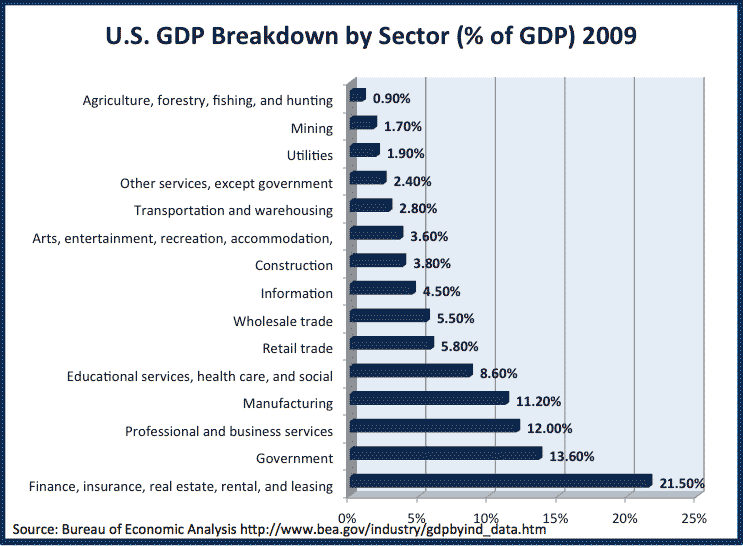
One thing that is clear looking at this graph is how much household consumption contributes to our GDP.  Housing and Utilities purchases alone ($2.0 trillion) exceed all Federal spending, which amounts to a little over $1.2 trillion.  Business investment contributes significantly to our GDP as well. The takeaway from this is that if we really want to boost our economy, finding ways to promote consumers to spend more money is the way to go.  Here is a breakdown, by sector of the economy, of our GDP. This one references the GDP of 2009.


The percentages change from year to year, but generally we can see what parts of the economy are most important.  Here's how the US fits into the larger world picture:


As we can see, the United States is a large portion of the world economy.  It is the largest portion, in fact.  This means that the United States occupies a very important role as a producer and consumer of world goods.  What affects the United States affects the whole world.  We have seen this with the current financial situation.  When the United States was drawn into a deep recession, so to was most of the world.  In this country, we need to be mindful that our fiscal policies have a very wide ranging impact.  The same can be said for other countries in emerging markets.  When a single country occupies such a large slice of the world economy, their actions have huge consequences.

Here's a breakdown by state of our country's GDP:


The same lessons can be learned from this graph.  California, as a large slice of the pie in America, affects many citizens all around the country because of their decisions.  Indeed, they also occupy a large portion of the world economy.  Silicon Valley, the entertainment industry, and agriculture are all huge parts of the world economy. Small decisions in Los Angeles or San Jose or even Salinas can have impacts on a large stage.

Our Ideas:

With all this in mind, we can figure out efficient ways to boost our domestic production.  Increasing consumer spending and business investment is of paramount importance.    By keeping interest rates down in a bad economy, more money can be freed up for consumers and businesses, so that they can spend it in the economy.

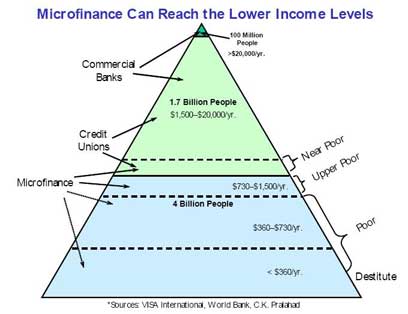
More needs to be done however.  We advocate applying principles of microlending to local communities in order to elevate people into economic success and sustainability.  We have outlined such a proposal in a previous post.  While this is not a sole solution, it could go a long way to providing funds for consumers and small businesses.


In hard times, we also need to empower these same small businesses by lowering their tax rates.  Small and medium sized businesses drive both business investment and household spending, so increases there will make a significant difference.

Additionally, much has been made of the United States' trade deficit.  In the topmost graphic, you will see a negative number for net exports.  In the graphic below, you will see the net exports as an overall percentage of our GDP.


This is not necessarily a bad thing.  Even though our trade deficit is large, it is only a small percentage of the total economy.  Even if the gap got bigger, it would not necessarily mean that our economy would be worse off.  If we go by the economic principle that trade increases wealth, a country with a trade deficit, if efficient, will make up that loss in some other area of the GDP.

We do this by specializing.  Importing items allows us to specialize in producing goods that we are especially good at making.  We don't have to be a large exporter to be a powerful economy.  If we have strong consumer spending and business investment numbers, as well as a certain amount of government spending, our economy will still be very strong for the future.  This country needs to work on exporting goods, but we need not worry to much about this trade deficit, as long as it stays within a small percentage of our GDP, because we can always specialize and produce something different, capitalizing off trade.